
Everything Great Hockey Is Supposed to Be
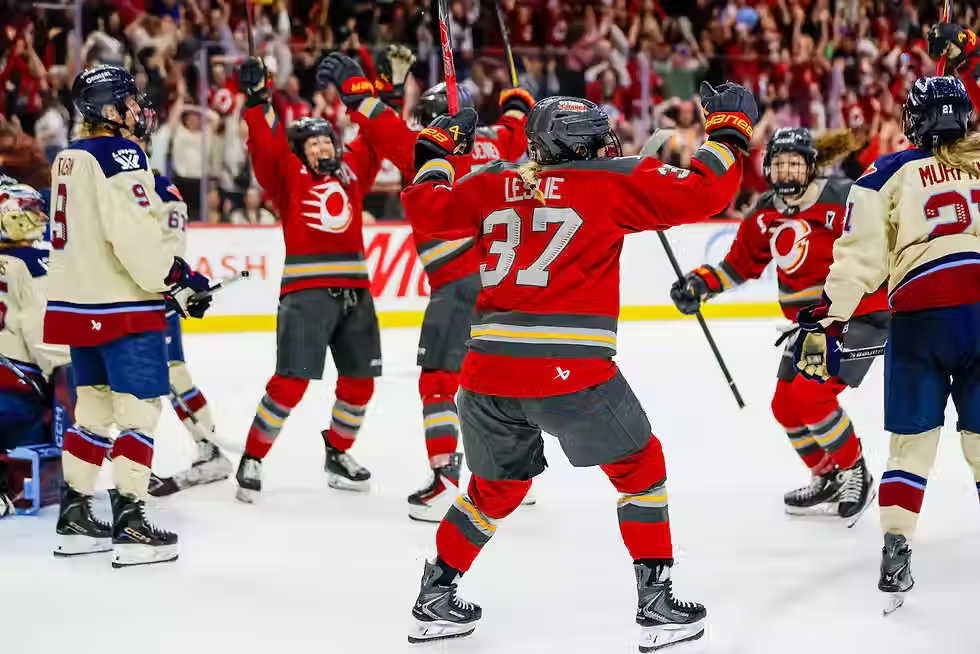
For a league built on atmosphere, the Walter Cup keeps getting won in silence. The Minnesota Frost won the Walter Cup on the road in both 2024 and 2025. In 2026, the Montréal Victoire came ready to do the same in Ottawa, becoming the first Canadian team to lift the Walter Cup – not in front of their own fans, but by silencing nearly 13,000 opposing ones.
That says something important about the Professional Women’s Hockey League (PWHL) right now: nobody runs through this league comfortably.
The first two games of the Finals went into overtime. Ottawa entered the playoffs as the fourth seed and still pushed Montréal into another tight, emotional series. Every playoff round has felt defined by one-goal games, momentum swings, and hostile road environments that somehow still fail to guarantee wins.
In many leagues, loud buildings and playoff momentum eventually overpower opponents. In the PWHL, the best teams seem capable of absorbing all of it. Montréal did not look rattled by Ottawa’s crowd. Minnesota did not look rattled in Boston or Ottawa before them. If anything, the Walter Cup’s short history is beginning to establish a different pattern: championships in this league are earned by the teams that can control chaos on the road.
And maybe that is the clearest sign of how strong the level of hockey has already become.

The PWHL still feels young in so many ways: expanding fanbases, growing rivalries, record-setting attendance, and players becoming household names in real time. But the hockey itself already looks remarkably mature. There are no easy playoff matchups. No overwhelming dynasty. No team cruising through rounds untouched. The margins feel incredibly small, which makes every mistake, every overtime bounce, and every road-period momentum swing feel enormous.
“Once we realized what it was going to take, the pursuit of that became the obsession. We have to look at every moment along the way, free-agency, our drafts, our trades, and the amazing team we’ve been able to put together all year long,” said Kori Cheverie, Victoire head coach.
That level of balance is not always common in young leagues. Often, early professional leagues are dominated by one or two superteams stacked with national-team talent. Instead, the PWHL has produced something much more competitive. The standings stay tight. Lower seeds stay dangerous. Crowds matter, but they do not decide games on their own. And with four more teams joining the league through the expansion, the depth of talent across the PWHL is about to be tested even further.
So, the most important takeaway from Wednesday night may not have been who won, but what the series revealed about the league itself: any team can be beaten, anywhere.
And in playoff sports, uncertainty is what keeps people coming back.
Maybe that’s what made Wednesday night feel so significant.
This was not just another championship celebration. It was the Montréal Victoire becoming the first Canadian team to win the Walter Cup, led by a roster filled with some of the biggest names the sport has produced. It was years of Olympic moments, national team dominance, and growing visibility for women’s hockey finally translating into a professional championship moment on Canadian ice.
And fittingly, Marie-Philip Poulin was at the centre of it again.
Poulin did not score in Game 4, but her presence still hovered over the series in the way legendary athletes often seem to. Every touch of the puck shifted the energy inside the Canadian Tire Centre. Every introduction drew noise from both sides of the rivalry. By the end of the night, she was named winner of the Ilana Kloss Playoff MVP Award – another honour added to a career that already feels inseparable from the story of Canadian hockey itself.
In a league still creating its traditions, icons, and defining championship imagery, the Walter Cup being raised by Montréal while Poulin accepted playoff MVP felt like one of those moments people will reference years from now when talking about the early identity of the PWHL. Not because it was perfect or scripted, but because it felt meaningful. Established. Big.
What stood out most, though, may have been the crowd itself.
Even after watching their own season end, thousands of Ottawa fans stayed in their seats for the trophy presentation. They applauded Montréal. They applauded Poulin. Some stood with phones raised recording the moment, while others simply watched quietly as one of the greatest players in women’s hockey history added another defining accomplishment to her career.

In most sports, championship celebrations on opposing ice are meant to feel hostile. This felt different. Emotional, yes. Heartbreaking for Ottawa fans, absolutely. But they were also deeply aware of the significant moment unfolding in front of them.
Around the ice, towels still spun through the air. Montréal players piled against the boards in celebration. And inside a building that had spent the last week believing it could become part of history itself, it somehow still did.
It felt like the kind of playoff moment major sports leagues are built on: hostile road wins, emotional crowds, history unfolding in real time, and a building that stayed until the very end.
Edited by Mithzi Silva


hi
Everything great hockey is speed, grit, grace. As a PhD student who works part-time at Last-Minute Assignments, I fell in love with the game during college, watching games instead of studying. I was so hooked that I'd search for best assignment service UK just to watch the playoffs. Your post captures the essence. Thank you for that. Ice, sticks, heart. Grateful for the poetry. Keep celebrating sports. Seriously, my appreciation for hockey grew. Here's to the beautiful game on ice. Thanks for the tribute. Cheers.