
A Beginner's Guide to the F1 Weekend
- Qulzum Nafees
- Mar 12
- 3 min read

Have you ever turned on a Formula 1 race and wondered how we got from a random Friday session to lights out on Sunday? Formula 1 (F1) is the highest class of international racing for open-wheel formula cars, featuring 10 teams with 2 drivers each competing in 24+ Grand Prix races worldwide. A few common terms you need to know to fit in are Pit Stop: a 2-3 second stop to change tires, DRS (Drag Reduction System): a rear wing flap that opens on straights to increase speed for overtaking, and Grid: the starting order for the race. A typical F1 weekend is a three-day event that slowly builds up to the race itself, and each session serves its own purpose.
How does a Grand Prix weekend work? Here's a quick breakdown:
Friday: Practice and Pace

Race weekends usually start on a Friday (track time) with two hour-long practice sessions: Free Practice 1 (FP1) and Free Practice 2 (FP2).
These sessions are where teams experiment with car setups, tire choices, and fuel loads. Drivers test out what works best for the track, given the location's track conditions. It's also when some test/reserve drivers get a chance to jump into the car and gain experience.
Nothing official happens here, but teams gain massive amounts of data that shape the rest of the weekend.
Saturday: Final Practice and Qualifying

Saturday starts with Free Practice 3 (FP3). This final hour-long practice session gives the teams more time to fine-tune their set-ups before parc ferme conditions begin, and most work on the car is banned. Parc ferme is a secure, monitored area in Formula 1 where cars are held immediately after qualifying and before the race to prevent unauthorized, major, or performance-enhancing modifications. During this time, only minor, approved adjustments, like tire changes or engine cooling, are allowed under strict FIA surveillance.

After that, we go into qualifying, which determines the starting grid for Sunday's race. The starting grid is the arranged, two-by-two lineup of cars on the track, which determines the starting order for a Grand Prix.
Qualifying has three "rounds" that last for 18, 15, and 13 minutes, respectively:
Q1: All drivers put in a lap time, and the slowest 6 are eliminated.
Q2: The remaining 16 drivers fight for a spot in the top 10.
Q3: The final 10 drivers fight for pole position, the desired P1 starting spot.
Starting near the front is important in F1 because it provides a strategic advantage, offering a cleaner path to the first corner and reducing the risk of collisions. Qualifying is sometimes said to even predict the race outcome.
Sunday: Race Day

Sunday is what everyone has been waiting for: the Grand Prix! This event is held over a minimum distance of 305 kilometres, and so the number of laps at each event will be the fewest number of laps needed to exceed that distance.
Drivers line up on the grid based on yesterday's qualifying results, and it's lights out and away we go.
Strategy is key here. Teams have to choose the most optimal time to pit, what tires to use, and how to react to things like safety cars and on-track drama.
The top 10 drivers get points, with the winner getting 25 towards the coveted World Driver's Championship.
The Weekend As a Whole
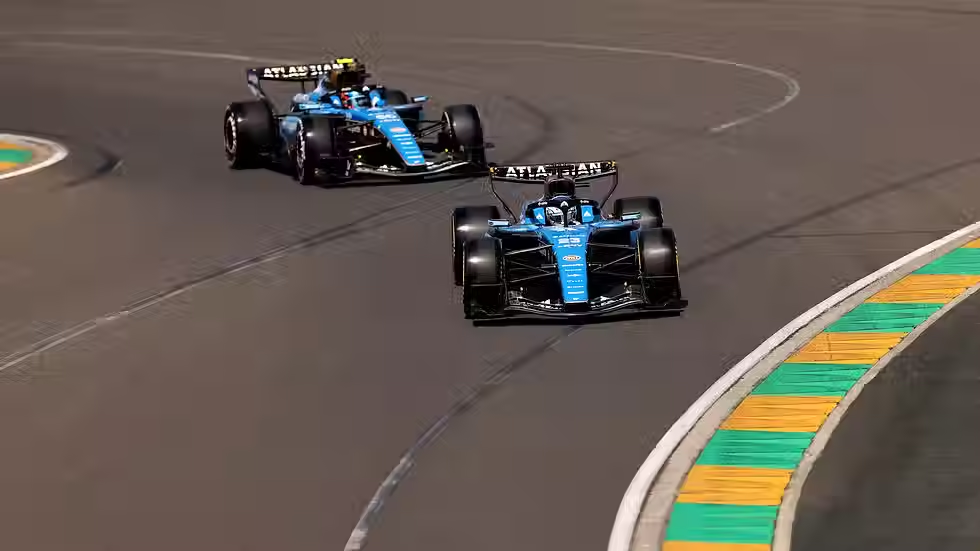
The Formula 1 race weekend isn't solely about the race. It's built on practices that reveal pace, qualifying that sets a stage, and a Sunday full of drama.
It's a new season, and we can't wait to see where each weekend is going to take us!
Edited by Olivia Feldgus


Comments