
Breaking Barriers and Shaping the Future: The Rise of Caroline Harvey and Laila Edwards
If you watched the Olympics, you know who Caroline Harvey and Laila Edwards are. You heard their names chanted countless times as Team USA powered through the tournament. You heard those chants again when gold medals were placed around their necks, and you watched Harvey be named tournament MVP. And if you're active on social media, you may have even caught their pregame TikToks, too.
What you may not know is how long the two have been friends.
Edwards recalled one of the first times they met back in 2012, saying, "I was probably 8 or 9, and KK was 10. We were playing in a tournament together in Boston on the Pittsburgh Penguins Elite and she had this hideous helmet." From that moment on, the two became close friends and eventually teammates at the collegiate level and on the national team.
Both athletes were recruited by Bishop Kearney High School and played for the Selects Academy before continuing to the University of Wisconsin. They weren't the only alumnae from the Bishop Kearney Selects hockey program to reach the Olympic stage. In fact, eight former BK Selects traveled to Milan to compete in the Games.

Despite being just 23 years old and still a senior in college, this was not Harvey's first Olympic appearance. She made her Olympic debut in 2022, earning a silver medal with Team USA at the Beijing Olympics when she was only 19—before she had even begun her college career. Her role then looked far different, and Harvey described herself as a "sponge", soaking everything in while finishing the tournament with the least amount of ice time among American players.
This time around, she arrived ready for more responsibility. "I'm definitely a lot more confident," Harvey said. "My role was a lot different during the Beijing Games, and using that experience, being a sponge, soaking it all in, I feel like I can take a lot away from that. Now I'm excited. Our goal, and a personal goal, is to have a gold medal around our neck when we leave."
And they delivered.
Harvey finished the tournament with nine points in seven games, two goals and seven assists, and played a pivotal role in Team USA's gold medal run. She was named tournament MVP and Best Defender, and, alongside Edwards, was one of six players selected to the All-Star Team.
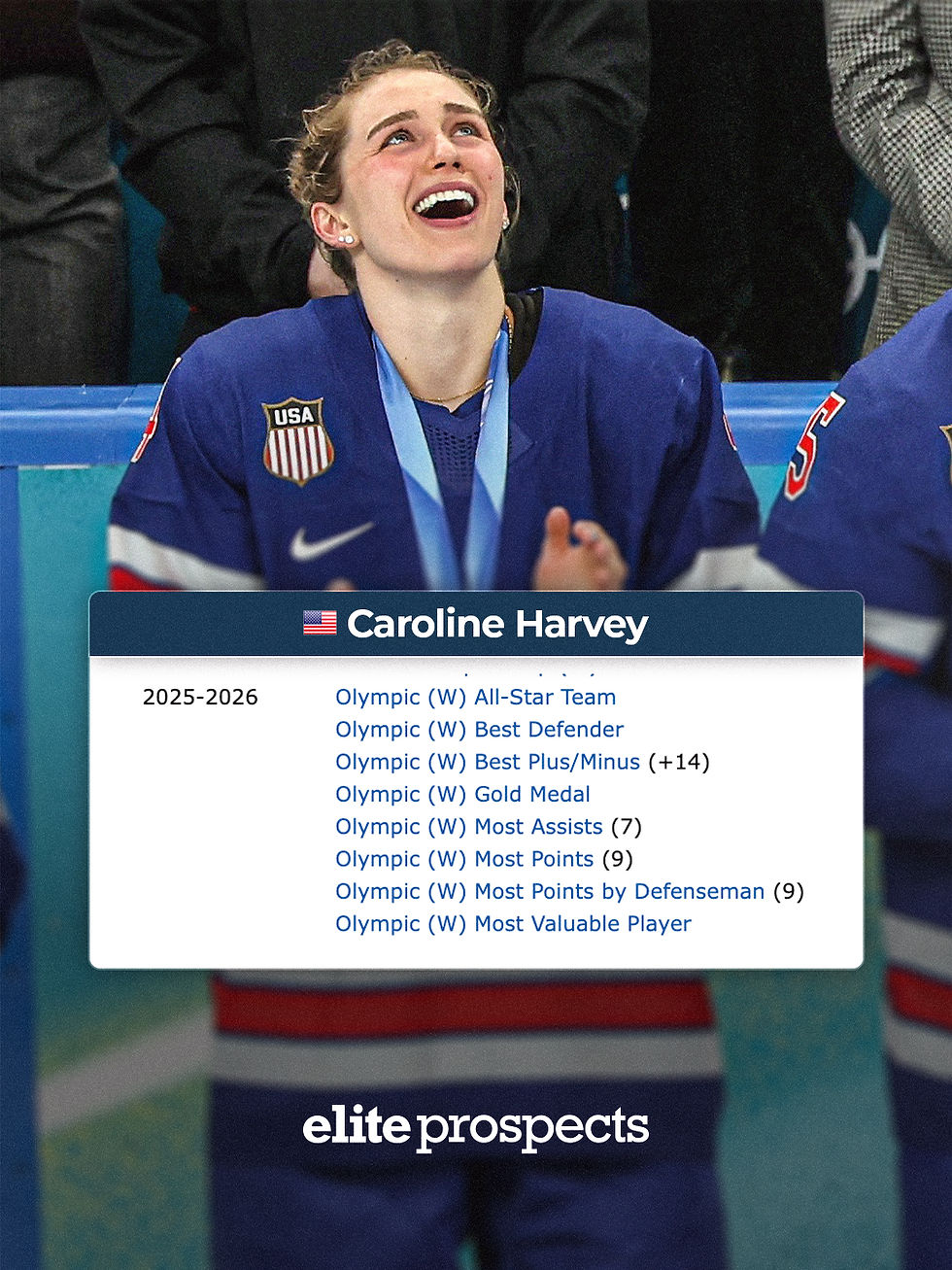
She accomplished all of this while still balancing college hockey and academics. Like many of the tournament's young stars, Harvey is leaving Milan and heading straight back to the NCAA. For her, that means returning to the top-ranked Wisconsin Badgers, where she is among the team leaders with 17 goals and 37 assists for 54 total points in just 26 games. When Harvey and Edwards rejoin the Badgers, they will jump back into conference play with the WCHA tournament before shifting focus to their final NCAA tournament run. The Olympic stars are already two-time national champions (2023 and 2025) and hope to earn a third this year.
Courtesy of Kyle_Cush/X
If you can't get enough of these players and start tuning into Wisconsin games, fans may be surprised to see Edwards playing forward. Despite suiting up as a defender at the Olympics, Edwards primarily plays right wing for Wisconsin—the position she grew up playing. After she made Team USA at the 2024 IIHF Women's World Championships, play development consultant Ellen Weinberg-Hughes approached Team USA head coach John Wroblewski with an unexpected idea. "You're never going to believe this, but Laila pulled me aside and said that she wants to chat about moving to defense."
What began as a joke, Edwards insisting she would do whatever it took to help the team, quickly became reality and today she is one of Team USA's most reliable defenders. In a modern game that relies heavily on elite two-way defenders, Edwards had all the tools to make the transition. At 6-foot-1, her long reach, strong skating, and hockey IQ allow her to expertly dictate the flow of the game from the back end.

What ultimately convinced Wroblewski was an analytical comparison. "I came upon a piece of information through an analytics department after I asked, 'How much does Quinn Hughes touch the puck compared to Elias Pettersson when they were in Vancouver together?'" Wroblewski said, "I learned that Quinn Hughes touched the puck twice as much as Elias Petterson. I just think it's the way the D can impact a game and the way they have the opportunity to impact the game way more often."
The move obviously paid off, as Edwards emerged as one of Team USA's most impactful players throughout the Olympic tournament. She finished with two goals and six assists for eight points and was named to the All-Star Team—an incredible achievement for any player, but especially for one still relatively new to the position at the international level. Edwards proved she could quarterback the back end and control the game against the world's best, illustrating just how influential modern two-way defenders can be.
Beyond the statistics, Edwards made history and helped pave the way for the future of the sport. She became the first Black American ever named to the U.S. Olympic Women's Hockey Team and is now the first Black American Olympic gold medalist in ice hockey history. Edwards understands the weight of that representation and embraces it.

"Plenty of people reach out and tell me that I inspire their kid to either start hockey or keep going, and it means the world to me," Edwards explained, "It's kind of what I do it for. I think the more I succeed at this level, the better it is for the representation."
For Edwards, success isn't measured solely in points or medals. It's reflected in the growing number of young players who can now see a future for themselves in the sport. Her story is proof of just how much representation truly matters.
What comes next for these players is no longer a question. For the first time, with the creation of the PWHL, a clear and viable path exists for women to pursue hockey as a professional career.
In a heart-wrenching moment during the broadcast of the gold medal game, this quote captured just how far women's hockey has come: "They used to ask you after the Olympics when we would see you play again and we'd say at the next Olympics but now we can say March 1st." The line served as a powerful reminder of the sport's growth and of the opportunities now available for women to continue playing hockey beyond the Olympic stage.
Following the conclusion of the current PWHL season, the 2026 draft will take place, with Caroline "KK" Harvey projected to be selected first overall. Edwards is close behind, currently projected as the third overall pick. Together, they stand at the beginning of a new chapter defined by the start of professional careers that once didn't exist.
From a "hideous helmet" at a youth tournament in Boston to gold medals on the world's biggest stage, their rise reflects not only how far they've come but how far the sport itself has progressed. And as they move forward, their impact will continue to extend well beyond the ice, helping shape the future of women's hockey for generations to come.
Edited by: Kelly Cassette


Comments