
Don’t Look Now: The Athletics Are First in the AL West
Early in the season, the American League has been defined by mediocrity and volatility. Only three of the 15 teams have a winning record, and the Athletics are one of them. At .525 themselves, they’ve somehow worked their way to the top of the AL West.
The start becomes even more surprising when considering the instability surrounding the franchise. Between temporary homes, playing in the minor league confines of Sutter Health Park in West Sacramento, an upcoming move to Las Vegas, and the organization’s transition away from Oakland, the Athletics have spent the past few seasons operating under constant uncertainty both on and off the field.
Despite that, the clubhouse has embraced its current situation rather than using it as an excuse. Speaking on the temporary move to Sacramento and the organization’s eventual shift to Las Vegas, outfielder Tyler Soderstrom said, "Our mindset is we want to win in Sacramento this year. We want to get to the postseason in Sacramento this year. That's been one of our big mottos actually this year, in spring and going into the season: we're going to win this year in Sac."
While that alone is notable, the more compelling story is how this team is coming together. Emerging young hitters, defensive growth up the middle, historic streaks, and a few unexpected breakout profiles are shaping an identity that feels sustainable.
A Young Core Setting the Tone
At the center of the A's early success is Jacob Wilson, whose development has quickly turned him into one of the most important players on the roster. The 24-year-old shortstop has been especially effective with runners in scoring position, consistently delivering in high-leverage moments and keeping innings alive with a contact-driven approach.
Wilson’s swing has been described as “twitchy,” as he shuffles around in the box with noticeable pre-swing movement and a wide-open stance that he believes helps him stay inside the baseball longer. He can often be seen choking up on the bat, prioritizing contact over power.

That approach extends beyond mechanics, as Wilson has leaned into an unconventional preparation method that he believes sharpens his decision-making. "Kids are going to love this one. Parents are going to hate me," Wilson said. "I am a big believer in video games. It's fast decision-making strategy. I think that gets me ready for the game, because when you're in the box, you have to process a lot. So there's some days where I'll wake up and I'll play video games and then I'll go to the field, and I'll have a good day. Some days I won't play and don't see the ball well. I think it really helps me train kind of the decision-making that I have to make six, seven hours later at the baseball field."
Whatever the method, the results have followed. Wilson has become a steady presence in the lineup, currently batting .292, and has established himself as one of the more reliable bats in key situations.
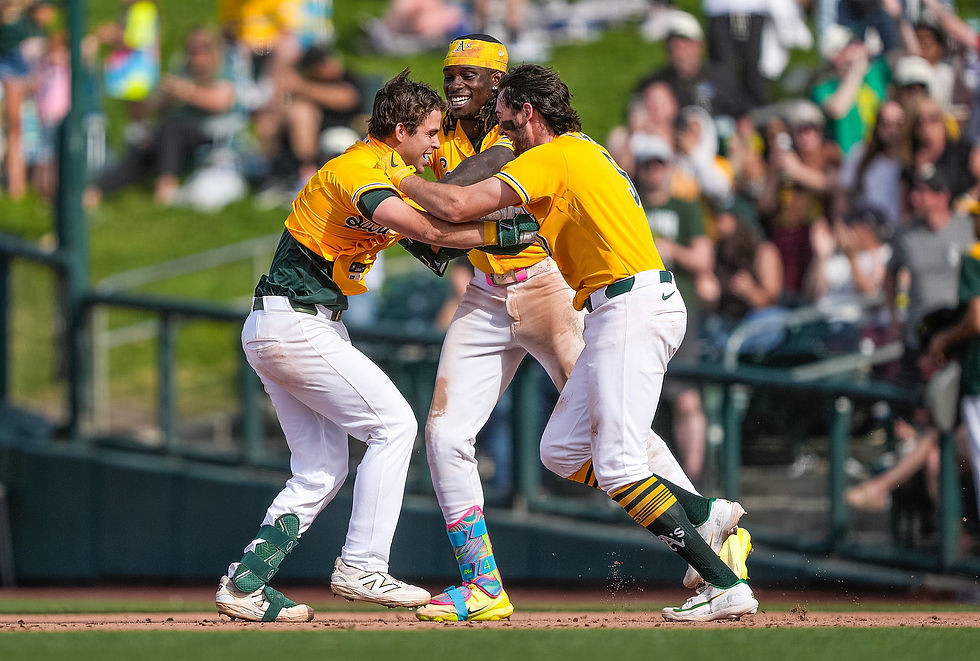
Alongside his offensive growth, Wilson has quietly become one of the most valuable defensive shortstops in the league. When he entered the majors, he was often labeled as a below-average defender analytically. This past offseason, he made that area a primary focus, working closely with Bobby Crosby to refine his infield habits.
Wilson said, "Being able to call him was great. We talked about how to read swings, anticipate swings, going through pitchers and seeing where the opposing team hits the ball off certain pitchers...it was a big learning process." The work has translated immediately. Wilson is currently tied for third in Outs Above Average among shortstops and ranks near the top of the list in runs prevented. His defensive impact is underscored by a franchise-record 78-game errorless streak, with his last error coming on July 6, 2025.
Between his growth at the plate and his emergence in the field, Wilson has become one of the clearest examples of the A’s internal development taking hold. He’s also quickly become a clubhouse favorite, with teammates Max Muncy and Tyler Soderstrom even serving as "flower girls" in his wedding, a lighthearted moment that fits the personality and chemistry he’s brought into the group.
Nick Kurtz and the Art of Getting On Base
If Wilson represents stability, Nick Kurtz represents discipline at its purest form. Otherwise known as "Big Amish", Kurtz is a first baseman known for his immense power, but his approach at the plate has become just as important as the damage he can do when he connects.
After winning AL Rookie of the Year in 2025, Kurtz has opened this season by building one of the most impressive on-base profiles in baseball. His 20-game walk streak recently came to an end, tying Barry Bonds for the second-longest such streak in MLB history. Only Roy Cullenbine has recorded a longer streak, reaching 22 consecutive games with a walk back in 1947. While his walk streak ended, Kurtz still holds the longest active on-base streak in baseball at 34 games, the longest by an A’s player since Matt Chapman reached 30 in 2018.
The advanced numbers help explain why pitchers continue to struggle putting him away. Kurtz ranks 39th among qualified hitters in the percentage of pitches he sees in the strike zone, meaning pitchers are actively avoiding giving him anything hittable. Despite that, he remains among the league leaders in chase discipline and swing rate metrics, consistently refusing to expand the zone and forcing pitchers into extended battles.
That combination has made Kurtz one of the most difficult hitters in the league to navigate. He rarely gives away plate appearances, instead creating value through patience, pitch recognition, and an ability to grind through deep counts. At just 23 years old, he continues to establish himself as an anchor near the top of the Athletics lineup.
Power Swings and Lineup Volatility
While the top of the order has stabilized the offense, the middle remains a work in progress. If the A’s want to keep building momentum, they will need more from Brent Rooker and Lawrence Butler. Battling both injuries and offensive struggles, Rooker opened the season 0-for-20, the longest hitless streak of his career. After grinding through seven difficult games, he finally broke through on May 1 against the Cleveland Guardians with a 422-foot home run that snapped the streak. As one of the emotional leaders in the clubhouse and a centerpiece of the lineup, the moment clearly meant more than just ending a slump. "I still have a long way to go," Rooker said. "Still not thrilled with the way my swing looks or how my mechanics are feeling, but I’ll keep working on it. The only way out is forward, so just keep pressing and trust the work and the process that’s gotten me to this point, and the results will follow."
Meanwhile, Butler remains one of the biggest X-factors on the roster. The tools are obvious, but consistency has yet to follow. Currently batting just .179 with a .560 OPS, Butler has struggled to find rhythm offensively to begin the season. If that changes, though, the entire lineup could look different. Right now, the Athletics are surviving on timely hitting, discipline, and defense rather than overwhelming offensive production.
Still, not every part of the middle of the order has been searching for answers. Lost in a lot of the attention around the younger hitters is just how dominant Shea Langeliers has remained. Between the power and the defense behind the plate, he’s turned himself into one of the best all-around catchers in baseball. His production has been instrumental this season, slashing .336 with 11 home runs, 22 RBIs, and a 1.011 OPS. Since July 1, 2025, Langeliers is one of two players with 30+ home runs and a 5+ fWAR—FanGraphs’ version of Wins Above Replacement, a metric used to estimate a player’s total value—trailing only Aaron Judge. For a player producing at an elite level on both sides of the ball, Langeliers remains criminally underrated.
Together, a resurgent Rooker, a more consistent Butler, and the continued dominance of Langeliers could elevate the Athletics’ offense from competitive to legitimately dangerous.

A Rare Profile: Carlos Cortes
Adding to the team’s uniqueness is Carlos Cortes, one of the most unusual players in baseball. Cortes is ambidextrous and the only MLB player who can throw with both arms, a rare defensive versatility that immediately sets him apart.
But his value isn’t limited to novelty. Early in the season, he was one of just two players in baseball ranking in at least the 90th percentile in both barrel rate and strikeout avoidance, a rare combination of power efficiency and contact discipline. While his barrel rate has since dipped closer to the 80th percentile, his strikeout profile remains elite, still sitting in the 99th percentile. His evolving production has translated to a .355 average and a .978 OPS. For a roster built around development stories, Cortes may be the most unique of them all.
The Next Wave
Perhaps the most encouraging aspect of the Athletics’ start is what still hasn’t arrived. A promising pipeline of young talent continues to develop behind the current roster, with names like Gage Jump, Jamie Arnold, and Henry Bolte representing the next group of potential impact players. Bolte, in particular, appears to be pushing toward a call-up sooner rather than later. Through the month of May, he is batting .632 with five home runs, 46 total bases, and a 1.861 OPS, continuing to strengthen his case for a promotion to the major league roster.
Courtesy of uprootedoakland/X
While still developing, each brings traits that align with what the current roster is already showing: athleticism, versatility, and upside. The A's are winning through a young core that continues to develop faster than expected, supported by defensive growth and balance throughout the lineup. In a season where much of the American League has struggled to separate itself, the A’s have quietly built one of the more intriguing foundations in baseball.
Edited by: Kelly Cassette


Comments