
From Normandale Field to Providence Park: The City That Built Women’s Sports
Out in the Pacific Northwest, Portland has long held a unique place at the center of women’s sports. Often overlooked nationally, the Oregon city has quietly built one of the strongest women’s sports cultures in the country through generations of institutional support, historic teams, and passionate fan bases that have consistently embraced women’s athletics as essential rather than secondary.
Now, that legacy is once again in the spotlight. With the return of the Portland Fire to the WNBA, the inaugural season of the Portland Cascade approaching, and the Portland Thorns FC sitting atop the NWSL standings, Portland has once again established itself as a global epicenter of women’s sports.
History of Women's Sports in Portland
The roots of Portland’s women’s sports culture stretch back nearly a century. In 1937, Dorothea Marie Lensch was named the first Director of Recreation within Portland's Bureau of Parks and Public Recreation, making her one of the only women in the country to hold such a position at the time. Lensch dedicated much of her career to creating recreational opportunities that were accessible to people of all backgrounds and abilities; however, her impact on women’s sports in Portland was particularly significant.
At a time when women's athletics were often dismissed or overlooked entirely, Lensch helped create an environment where women's sports were treated as worthy of equal investment and public support. That foundation would shape Portland’s identity for decades to come.
Softball and Queer Liberation
That same year, a softball team known as the Lind & Pomeroy Florists began to take shape. Sponsored and coached by Erwin “Erv” Lind alongside his business partner Seley Pomeroy, the team eventually became known simply as the Erv Lind Florists. As a softball fan herself, Lensch played a key role in supporting the team’s growth by helping provide the municipal infrastructure necessary for women’s softball to thrive in Portland.
The Florists quickly developed into an elite group, and by 1942, the team was already drawing large crowds at municipal fields throughout the city. As the level of competition continued to rise, the need for a permanent home became increasingly clear. That home arrived in 1948 with the completion of Normandale Field.
From 1937 to 1965, the Florists won more than 1,100 games while posting an all-time winning percentage near .775. During that stretch, they never lost a league, state, or regional title and captured the World Championships in 1944 and 1964.

In 1948, the Florists hosted the Amateur Softball Association World Championship tournament, drawing 44,000 fans during the tournament's opening week—more than enough to sell out today’s Moda Center twice over. The crowds foreshadowed Portland’s future as one of the country’s premier women’s sports cities.
But the significance of Normandale Field extended far beyond softball. At a time when queer Americans had few public spaces where they could safely gather, the Florists’ games became an important community hub for lesbians and queer Portlanders. As one woman later recalled, "There were two places where you could go if you were a lesbian—the bars or the Florists' games."
Today, Normandale Field is listed on the National Register of Historic Places because of its significance to Portland’s queer history. The community that formed around the Florists inspired future generations, including the Lavender Menace, one of the first openly gay softball teams in the United States. Founded in 1971, the Menace expanded beyond softball into basketball and volleyball while creating a visible and supportive community for queer women in sports.
Historian Celina Patterson described the significance of players like Maryann “Scrapper” McCormick by writing, "What was more remarkable was that McCormick was playing on a team full of athletic, openly gay women in an era when there were no girls’ or women’s sports in most high schools or colleges and when the vast majority of gay people were closeted in order to protect their jobs and their relationships with family and friends."

In the modern era, it can be difficult to fully grasp how courageous that visibility truly was. The women of the Lavender Menace created liberation for themselves and others by openly embracing their identities at a time when many queer Americans were forced to remain hidden. In doing so, they helped establish Portland not only as a city passionate about women’s sports but also as one where sports and community activism became deeply connected.
The Legacy of University of Portland Soccer
By the 1980s, Portland was beginning to establish itself as a national force in women’s soccer. In 1980, the University of Portland launched a women’s soccer program that would eventually become one of the country's premier programs. After competing in the NAIA through 1986, the Pilots transitioned to NCAA Division I competition in the West Coast Conference.
Under legendary head coach Clive Charles, the program transformed into both a national powerhouse and a pipeline for future international stars. Charles coached the Pilots from 1989 until 2003 before passing away from prostate cancer later that year. In his final season as a collegiate coach in 2002, Portland captured the NCAA National Championship in double overtime, honoring his legacy in the best way possible and claiming the first NCAA Division I title in school history.
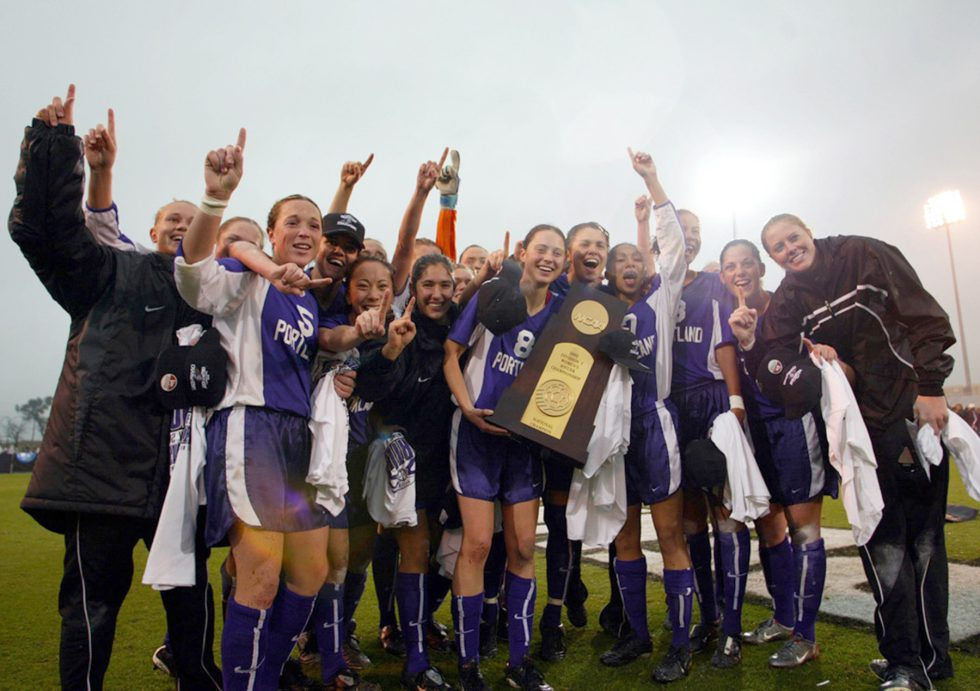
That same season, freshman Christine Sinclair led the nation with 26 goals and won the Honda Award, given to the best collegiate player in the country.
The Pilots reached another historic peak in 2005, when they finished the season undefeated at 24-0-2 to win a second NCAA championship behind Sinclair and Megan Rapinoe. Sinclair scored 39 goals that season, setting an NCAA single-season scoring record that still stands today.
The Burnaby, British Columbia native finished her collegiate career as one of the greatest players in NCAA history before later returning to Portland as one of the original members of the Thorns. She was the only player to be with the team throughout the entirety of its history until her retirement, becoming synonymous with soccer in the city. Even after hanging up her cleats, Sinclair has continued to shape the future of the sport as a co-owner and partner of Vancouver Rise FC in the Northern Super League.

Just as important as the championships, however, was the fan culture that developed around the program. From 2005 to 2014, the University of Portland led the nation in average attendance, proving that Portland was ready to support women’s soccer at the professional level long before most cities in the country.
The Rise of the Thorns and the NWSL
When the NWSL launched ahead of the 2013 season, the Portland Thorns FC were named one of the league’s inaugural eight clubs. Portland immediately embraced the team, and the Thorns rewarded that support by winning the first championship in league history later that year.
University of Portland alum and filmmaker Joe Kuffner once described the relationship between the city, the Pilots, and the Thorns by saying, "This city had been primed by decades of treating women's soccer seriously. If [the NWSL] didn't work in Portland, it couldn't work anywhere...I think you can easily make an argument that the NWSL wouldn't have lasted if it wasn't for the Portland Thorns and the support that team had early on to carry the league. And I think you can just as easily say that the Thorns wouldn’t have had that type of success without those UP teams that came before them.”
Over the years, the Thorns have become one of the most successful and recognizable clubs in women’s soccer. The team has won three NWSL championships in 2013, 2017, and 2022, while consistently setting attendance records and leading the league in fan support. This season, Portland set a new attendance record for a Thorns home opener when 21,321 fans packed Providence Park, further cementing the city’s reputation as one of the premier environments in the world for women’s soccer.
Ten games into the 2026 season, the Thorns once again sit near the top of the NWSL standings, looking to add to their league-record nine postseason appearances.
The Return of the Portland Fire
Portland’s commitment to women’s sports continues to extend far beyond soccer. The original Portland Fire existed in the WNBA from 2000 to 2002, playing their home games at the Rose Garden, now known as the Moda Center. Although the franchise lasted only three seasons, it left a lasting impression on the city.
More than two decades later, the Portland Fire have returned with renewed energy and overwhelming support from the city. In their inaugural game back, the franchise set a record for the highest attendance ever for an expansion team’s debut with 19,335 fans inside the Moda Center. Just a few days later, Portland earned its first victory after Sarah Ashlee Barker scored a buzzer-beating putback to defeat the New York Liberty.
Expansion and Cultural Growth
Now, Portland's women's sports landscape is preparing to grow once again with the arrival of the Portland Cascade in the AUSL in a few weeks. The addition of a professional softball franchise feels especially fitting for a city whose women’s sports history was built in large part on the success of teams like the Erv Lind Florists decades earlier. Playing out of Hillsboro Ballpark, the Cascade are one of two expansion teams debuting this season.
Portland's support for women's athletics extends beyond stadiums and arenas, permeating everyday life throughout the city. In 2022, The Sports Bra became the first sports bar in the United States dedicated exclusively to women's sports, quickly becoming both a national phenomenon and a reflection of Portland’s deep investment in women athletes and their fans. Today, the bar is expanding with new franchises opening across the country.
Founder Jenny Nguyen described the importance of this national growth, saying, "Together, we’re serving fans nationwide who are hungry for spaces that not only champion women’s sports, but create a community where everyone feels like they belong."
Long before women’s sports became a booming national business, Portland was already investing in female athletes, building communities around them, and treating their games as worthy of attention. From the Erv Lind Florists and Normandale Field to the University of Portland dynasty, the Thorns, the Fire, and now the Cascade, the city has spent generations proving what is possible when women’s sports are embraced rather than overlooked.
For Portland, support for women's sports is not a trend, it's an essential part of the Rose City's identity.
Edited by: Kelly Cassette



Comments